
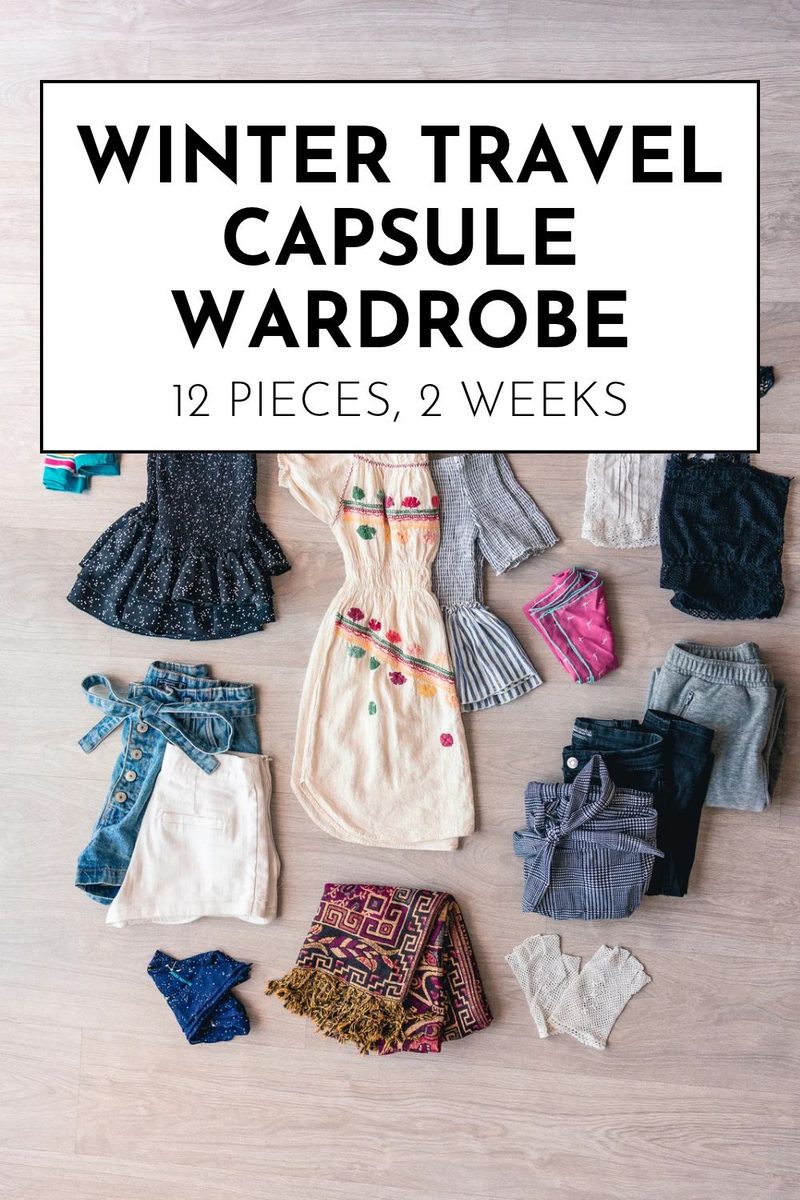
Most winter packing fails in the same place: the coat. It takes a third of the bag, and then you pack six sweaters to go with it. A winter travel capsule wardrobe flips that. Twelve pieces, one color family, three layers that mix with each other, and a bag you can lift into an overhead bin without a grunt. Below is the list, the math that stretches it across two weeks, and the laundry plan that makes the math work. For where to point it, start with where to go in December.
The 12 pieces at a glance
The count covers clothes you wear on your body in daylight. Shoes, underwear, socks, sleepwear and cold-weather accessories sit outside it (more on that cheat in a minute).
| # | Piece | Job |
|---|---|---|
| 1 | Insulated coat, hip to mid-thigh | Does all the heavy lifting outdoors |
| 2 | Light waterproof shell | Rain and wind, goes over anything |
| 3 | Fleece or packable vest | Warm middle layer, nearly weightless |
| 4 | Thick sweater | Cold evenings, long train rides |
| 5 | Thin knit sweater | Layers under or over the rest |
| 6 | Merino long-sleeve top, color A | Base layer, wears three or four days |
| 7 | Merino long-sleeve top, color B | Same, second color |
| 8 | Button shirt or flannel | Looks smart under a sweater |
| 9 | Dark jeans | The workhorse |
| 10 | Wool-blend or stretch trousers | Dinner, museums, anywhere jeans feel too casual |
| 11 | Thermal leggings or long underwear | Slides under everything on the coldest days |
| 12 | One dressy piece: knit dress, skirt or a third pair of trousers | The “we’re going somewhere nice” option |
That is it. Everything else is a small supporting cast.
Start with a three-color rule
Pick a base color and a partner. Navy and gray work, so do black and cream. Then allow one accent: a rust sweater, a green scarf, whatever you already like wearing. Every piece in the capsule should go with every other piece, and that only happens when you stay inside the palette.
The accent matters more than it sounds. Photos on day nine look a lot like photos on day two, and a single bright layer is the difference between “I wore the same thing” and “I wore the red one again.” Both are true, but only one of them looks intentional.
Skip patterns that clash with each other. A stripe on one top is fine. Stripes plus plaid plus a floral scarf means you’re packing outfits instead of a capsule.
Why three layers beat one big coat
The idea is plain: a thin base next to your skin, a warm middle, and a shell on the outside. You add and remove them as the day changes, and that flexibility is worth more than any single heavy garment. Two weeks away means a cold street at 8 a.m., an overheated museum at noon, a drafty café at 4 and a wind tunnel on the walk back. One thick coat cannot handle all four.
In our capsule, the base is pieces 6, 7 and 11. The middle is 3, 4 and 5. The shell is 1 and 2. The button shirt and the trousers are the connective tissue that make the outfit look like a person got dressed, not an expedition.
The base layer: merino, not cotton
The most useful single upgrade is a merino base layer. Wool holds heat even when it is a bit damp, dries slowly but doesn’t clam up, and resists smell for days. Cotton does the opposite: it soaks up sweat or snow, goes cold and clings. If you only buy one new thing for this trip, buy a merino top.
Expect about $60 to $120 each in 2026 for a decent long-sleeve, which feels steep next to a $10 cotton tee. It pays for itself the second time you wear it on day four without washing. Blends with a little synthetic fiber dry faster and cost less, though a pure merino top usually feels better against the skin.
Tip: air your merino top overnight instead of washing it. Hang it by an open window or on the back of a chair and it will be fine by morning.
How do you get 14 days out of 12 pieces?
You repeat, and you wash once. The key is knowing which pieces get worn again and which ones don’t.
Base layers, sweaters and jeans can be worn several times between washes. Merino tops go three or four days. A thick sweater goes a week, since it never touches your skin. Jeans last as long as you can stand them, say five or six wears. The pieces that get washed first are the ones next to your body: underwear, socks, the button shirt.
Here is a rough two-week rotation to show it. It is a pattern, not a prescription.
Days 1 to 4: merino A, thick sweater, jeans. Swap in the thin sweater on a warm day. Days 5 to 8: merino B, thin sweater, trousers on the nicer days. Day 7 or 8: laundry day (see below). Days 9 to 12: merino A again, button shirt under the thick sweater, jeans. Days 13 and 14: merino B, dressy piece for the last dinner, jeans for the flight home.
If it seems repetitive, that is because it is. Nobody you meet on the trip will track what you wore on Tuesday. Honestly, you won’t either.
Laundry: the one wash that makes it work
Plan exactly one real wash, around the halfway mark. A hotel laundry service, a laundromat, or a washer at an apartment rental all work. Do the math before you go: if the first week of laundry is five days of underwear and socks plus two tops, it is one small load.
For everything else, use the sink. Underwear and socks wash in the bathroom basin with a little soap and dry overnight on a towel rail if the room is warm. Merino dries slower, so give it a full night and a rolled towel to squeeze out the water. Skip dryers for wool: they shrink it, and a shrunk merino top is a very expensive child’s shirt.
Note: not every room has a heated towel rail. Check before you rely on it, or pack a couple of travel clothespins to hang things near a radiator.
What doesn’t count in the 12
This is the cheat, and we’d rather say it plainly than hide it. The twelve are the outer clothes you see in photos. On top of them, you still pack:
- Seven pairs of underwear, since they dry fast and you wash them as you go
- Five pairs of wool socks, because cold feet ruin everything
- Sleepwear, one set
- A hat, gloves and a scarf, which weigh almost nothing and do a lot
- A swimsuit, if your hotel has a pool or hot spring
That is about a quarter of a small bag. It still fits.
Shoes: two pairs, one you wear on the plane
Two pairs, no more. The first is a waterproof boot with real grip, something you can walk in for eight hours on wet pavement. Prices run from about $90 for a basic pair to $250 or more for a good leather one in 2026. The second is a clean sneaker or a flat that works indoors and with the dressy piece.
Wear the heavy pair on the plane. Boots are the bulkiest thing you own, and wearing them is free luggage space. Your feet will be a little warm in the airport, but they won’t be in a bag.
The coat decision
The coat is the one piece worth spending real money on. You want it warm enough for the coldest day of the trip, and short enough that it doesn’t take up half the carry-on if you ever need to stuff it. Down or a good synthetic fill both work. Down is lighter for its warmth; synthetic copes better with wet.
A coat that ends around mid-thigh is the sweet spot. Longer looks great but gets heavy and wet at the hem. Shorter leaves your legs cold on a windy corner.
Tip: buy the coat a size up if you plan to wear the thick sweater and the vest under it. Try it on with both.
Will it fit in a carry-on?
Yes, if you roll the soft things and keep the coat on your back. The common limit at the big US airlines is 22 x 14 x 9 inches including wheels and handles. Two caveats: United’s domestic Basic Economy fares allow only a personal item that fits under the seat, with a full carry-on costing extra, and low-cost European carriers are stricter again. Ryanair’s free bag, for instance, is 40 x 30 x 20 cm. Check the size and fare rules for your own airline before you buy the bag, not after.
If your trip is cold enough to need a bigger coat, you are probably wearing it through the airport anyway. That is the whole trick: your heaviest items travel on your body, not in your bag.
Liquids follow the TSA’s 3-1-1 rule in the US: containers of 3.4 ounces (100 ml) or less, all in one clear quart-size bag. Solid shampoo bars and solid deodorant sidestep it entirely, which is one more reason to pack them.
Tip: do a practice pack at home a week before. If it doesn’t zip with the coat on the hook, something has to go, and it is far easier to decide that on your bedroom floor than at a check-in desk.
What would you change for a snow trip?
A capsule built for cities in the cold does not cover a trip to a ski town or to Iceland. Swap in these changes and keep the rest:
For deep snow, swap the sneakers for a second pair of insulated boots, or use a single serious pair and skip the second. Add waterproof gloves, because wet wool gloves lose the fight quickly. Trade the dressy piece for a second pair of thermal bottoms. And the waterproof shell becomes a proper shell with a hood that fits over a hat.
For a trip split between a cold city and somewhere warm, wear the heavy pieces on the travel day and fold the rest. A merino top and the thin sweater work as the warm-weather layer too, which is another reason the capsule leans on them.
Five mistakes that wreck a capsule
Packing for the worst day. You will not be walking outside at the coldest hour of the coldest day with nothing else to do. Pack for the average day and carry a layer for the cold one.
Buying clothes you don’t already like wearing. A trip is a bad time to find out a new sweater itches. Wear everything at home for a few days first.
Too many “just in case” pieces. A third pair of trousers “just in case” is how a capsule turns into a regular suitcase.
Forgetting that hotels are warm. Rooms and trains in winter are often heated hard. The thin sweater earns its place there more than the thick one.
Skipping a wash. The plan only works if the one wash actually happens. Put it in your schedule.
The final check
Lay all twelve pieces on the bed before you pack. Count them. Then put on each outfit in your head, one by one, and ask if you can make at least five different looks. If you can, the capsule works. If one piece only goes with one other piece, swap it for something that goes with three.
Then pack the bag, wear the boots, and leave the extra sweater at home. You won’t miss it.









Leave a Reply